Nobody's Been Sued for an AI Track in an Ad. Yet.
AI music is already in ads and films, mostly on terms that push every risk onto the user. Nobody has been sued for it in a campaign yet. That makes it untested, not safe. Here's where the legal ground is now, where it's heading in a year, and what's left for human music when it finally clears.
The short answer
AI-generated music is already in campaigns and films. Most of it sits on terms of service that give you permission to use the track and nothing else: no warranty, no exclusivity, no indemnity.
Brands get sued over uncleared music in ads all the time. In October, Warner sued Ray-Ban's owner for $64 million over unlicensed songs in social ads. But as far as I know, nobody has been sued over an AI track in an ad yet. That doesn't make it safe. It makes it untested.
The more interesting question isn't whether it's legal today. It's what happens as the legal ground clears, because it will. I think about it as a clock with three positions: now, in a year, in two years.
I'm not a lawyer, and this isn't legal advice. It's a working music supervisor's read, dated October 2026, because this ground moves every month.
Now: permission without protection
In September I read the current terms of five tools that agencies and productions actually use: Suno, Udio, ElevenLabs Music, Adobe Firefly and Google Lyria. The full breakdown is here. The short version:
- They all let you use the output in some form, except Udio, which since its Universal settlement allows no commercial use on any plan.
- Almost none takes responsibility if a track infringes. Suno caps what it owes you at $100 or six months of fees, whichever is greater. Google offers no indemnity for its music model, even though it indemnifies its image and video models.
- The one written music indemnity, Adobe's, is capped at $10,000 per output on standard team plans and excludes editing, combining with other material and "context of use".
On the legal side, the first big ruling against an AI music generator came in July 2026. In GEMA v Suno, a Munich court found both the training and specific outputs infringing, and held Suno responsible for those outputs, because GEMA's prompts only gave lyrics, title and style. That sounds reassuring until you notice what wasn't decided: whether a user could be liable too was never the question in front of the court. There's no ruling that protects you. Cases in Denmark, Canada and the US are still running.
And it's already happening in the open. In September the Danish electronics chain Power ran an ad with a Suno track. A Danish singer called it out publicly; no lawsuit has been reported. That's in the same market where Koda, the Danish collecting society, is suing Suno.
So where does the risk actually sit today? Not with the tool. In the contract chain. An agency warrants to its client that the music in the spot is cleared. The client warrants the same to the broadcaster or the platform. Suno, meanwhile, has capped its own exposure at the price of a dinner.
Here's how a lot of decisions get made right now: the agency tells the client AI was involved, the client says yes, and with that "yes" the client takes on a risk it usually doesn't understand. Nobody is lying. Nobody is really deciding either.
In a year: licensed models, and everything gets marked
The direction is already visible. Udio licensed with most of the majors and publishers, Sony excepted, and became a walled garden you can't download from. Suno's newest models were launched with Warner, BMG and Believe as partners, and Universal and Sony are suing over exactly those models. ElevenLabs says its model was trained on licensed music. Adobe indemnifies. Production libraries are moving in too: Artlist now sells AI music generation built on Google's Lyria, and Epidemic Sound uses AI to adapt its human-made catalogue. I expect that within a year, "is there a licensed option?" will have a yes for most uses.
At the same time, the EU AI Act has started to mark this music. Since 2 August 2026, providers of generative tools must mark their audio output in a machine-readable way so it can be detected as AI-generated. Tools that were already on the market have until 2 December 2026 to comply. Anything generated before 2 August doesn't have to be labelled retroactively. Separately, if you put out a deepfake, say a vocal that passes for a real singer, disclosure is your obligation and it already applies.
Put those together and the risk changes shape. When everything is marked and detection keeps improving, the question stops being "is this AI?" It gets much easier to tell. The question becomes "did you tell me?" A spot that runs for two years will likely outlive the period when nobody could check. Undetected was never the same as cleared. It's about to stop being undetected.
In two years: the legal argument is gone
This is the uncomfortable part. If licensed AI music becomes cheap, clean, indemnified and everywhere, and I think it will, the legal case against it disappears. "It might infringe" won't work as an objection anymore. So what's the case for human music then?
First, be honest about who loses first. It's the low-budget end: the cheap library cue under a social ad, the background bed for a corporate film, the commission that was never going to pay much anyway. That work is already moving to generators, and clean tools will speed it up. If your business lives there, the clock is already running.
I sat on a panel about exactly this at SoundTrack_Zurich in October, "Production Music: Creative Answers to AI". We didn't agree on much, which was the useful part. Martin Villiger, a film composer with more than 130 documentaries behind him, put it in a way I keep coming back to: AI is very good at the acceptable, middle-of-the-road answer, and a lot of music was middle-of-the-road long before AI arrived. That's the part that goes first. What stays worth paying for, whether you license it or commission it, is the track that does the less expected thing.
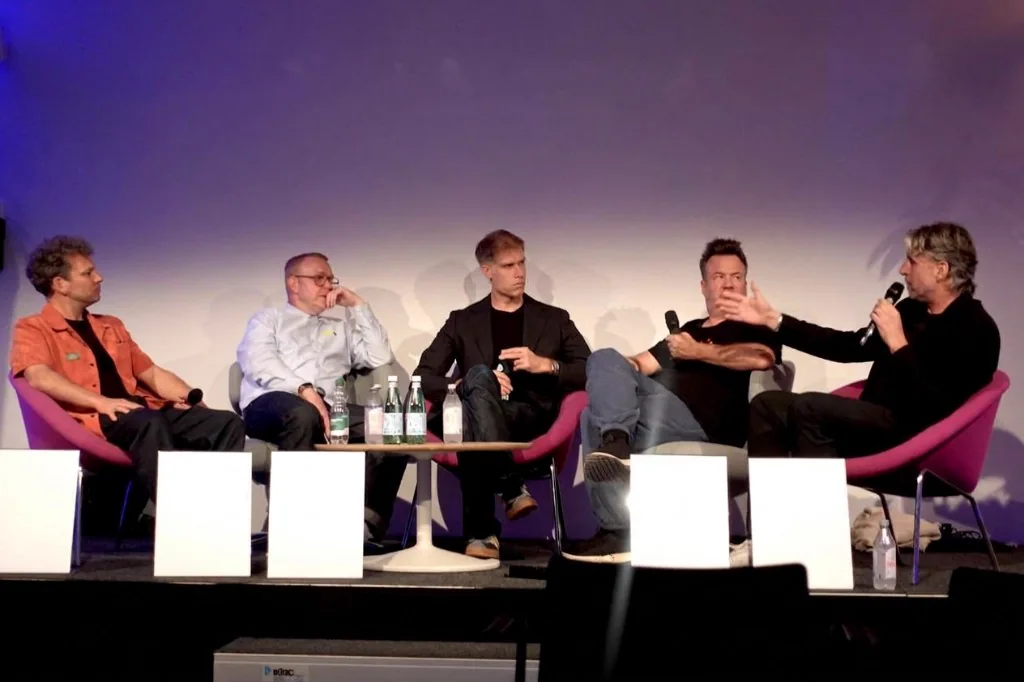 Production Music: Creative Answers to AI, SoundTrack_Zurich, October 2026. From left: Renato Horvath, Alexander Black, Olav Lervik, Adrian Frutiger, Martin Villiger.
What doesn't move:
- The song people already know. You can't prompt your way to a song the audience already has memories attached to. A known track in an ad sells recognition, and a generator can't produce recognition. It can only imitate the sound.
- Imitation stays the trap. When the brief says "something like X", the AI version that sounds most like X is the one most likely to draw a claim, licensed model or not. Adobe already refuses prompts that name an artist, band or song.
- Someone who signs. A human composer or a rights holder can stand behind a track, warrant it and be accountable for it. That stays worth something as long as clients and broadcasters want a name on the paperwork.
- The decision itself. Where in a campaign does music get generated, where does a known song go, where do you need a composer? Somebody has to make that call, and I don't think it will be the tool.
One more open question for the next two years: should a track say what's in it, like a label on food? The marking rules are pushing us there anyway. I'd rather the industry decide what that label says before a regulator does it for us.
What to do this quarter
If you're using or approving AI music now:
- Write it down. Tool, plan, model version, date, prompt, and a copy of the terms as they stood that day. If questions come in two years, that file is all you have.
- Check the plan covers the medium. Some self-serve plans, ElevenLabs' for example, exclude TV, film and radio. The tool working fine tells you nothing about whether the licence covers broadcast.
- Tell the client in writing, and say what it means. Don't stop at "AI was used". Say who carries the risk if a track is challenged, because on most public terms, nobody but you does.
- Never brief "make it sound like X". That's the claim magnet, whatever the tool.
- If the brief really is a known song, price the real thing first. Sometimes it's closer to the budget than people assume, and you won't know until you price it. It's also the one thing a generator can't give you.
I'm running a closed working day on this
On 18 November I'm running a closed working day on exactly this question at Linecheck in Milan, as part of Act in Synch: "The legal clock: generative AI and music in media". In the room: Sizzer, Bridge.audio, Cataloge.ac, the Music Supervisors Guild EU and UK, major ad agency networks and filmmakers. We'll work through what to tell clients about AI music now, and what changes when the legal ground clears. If you'd like to hear what came out of it, get in touch.
Key takeaways
- Brands get sued over uncleared music in ads all the time, but nobody has been sued over an AI track in a campaign yet. That makes it untested, not safe.
- Today the risk sits in the contract chain: agencies warrant clearance that the tools don't back.
- From 2026, AI audio gets marked in the EU. The question shifts from "is it AI?" to "did you disclose it?"
- When licensed AI is cheap and clean, the low-budget end goes first.
- What stays human: the known song, the person who signs, and the decision about where music comes from.
Frequently asked questions
- Has anyone been sued for using AI music in an ad?
- Not that I know of, as of October 2026. Brands do get sued over uncleared music in ads, but the AI music litigation so far targets the AI companies. In GEMA v Suno (Munich, July 2026) the court found specific outputs infringing and held Suno responsible for them; whether a user could be liable too wasn't in front of the court. So using AI music in a campaign is untested, not proven safe.
- Does AI-generated music have to be labelled in the EU?
- Since 2 August 2026, the EU AI Act requires providers of generative tools to mark their audio output in a machine-readable way so it can be detected as AI-generated. Tools already on the market before that date have until 2 December 2026. Content generated before 2 August doesn't need retroactive labelling. If you publish a deepfake, such as a vocal that passes for a real singer, disclosure is your obligation as the user.
- Will licensed AI music replace licensed songs?
- At the low-budget end, it's already happening: cheap background cues, beds under social ads, low-paid commissions. A known song is different. Its value in an ad is recognition, the memories the audience already has attached to it, and a generator can only imitate the sound, not produce the recognition.
Renato Horvath
Music supervisor and licensing expert with over a decade of experience in film, advertising, and content production. Founder of Eastaste (2012) and member of the UK & European Guild of Music Supervisors.
Related articles
Why ChatGPT Can't Tell You Who Owns a Song's Rights
AI and Google give you a plausible publisher name. Clearance needs the exact recording, every writer, and every publisher share. Here is the difference, and why the gap can sink a deal.
How Long Does It Take to Clear a Song? (Real Timelines)
Honest clearance timelines by scenario, from 3 days for a one-stop indie track to 3 months for an estate-controlled classic, and what actually causes the delays.